JAY-Z KEEPS PRESSING ‘ON TO THE NEXT ONE’
PAGE 19
WEEKEND ARTS
WEEKEND
A LITTLE EDO IN TOKYO’S BACKYARD
PAGE 24
BOLD WORK BY ITALY’S ENIGMATIC BOHEMIANS
PAGE 21
WEEKEND ARTS
‘MAKE IT NEW’ IS GRAND PRIX GOLDEN RULE
PAGE 11
FOR FASHION, A BAD CASE OF THE BLUES
PAGE 15
SPECIAL REPORT
TRAVEL
BUSINESS
SATURDAY-SUNDAY, SEPTEMBER 12-13, 2009
THE GLOBAL EDITION OF THE NEW YORK TIMES
GLOBAL.NYTIMES.COM
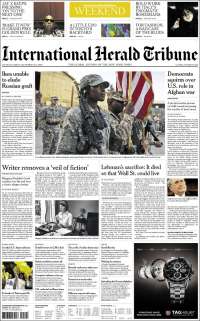
Ikea unable to elude Russian graft
MOSCOW
BY ANDREW E. KRAMER
Democrats squirm over U.S. role in Afghan war
WASHINGTON
Weeks before the opening of its flagship store outside Moscow in 2000, Ikea was approached
by employees of a local utility company. If Ikea, a Swedish retailer, wanted to have
electricity for its grand opening, it had to pay a bribe. Instead, Ikea rented diesel
generators large enough to power a shopping mall. The generators roared to life in
a loud rebuke to the corrupt executives who thought they had the retailer cornered,
and soon the utility turned on the power. As Ikea opened stores across Russia, and
became one of the most outspoken Western corporate critics of Russian corruption,
Ikea executives took great pride in their creative responses — renting generators
‘‘instead of putting ourselves into a squeeze,’’ as Christer Thordson, an
Ikea board member and global director for legal affairs, put it during an interview.
Only, Russian graft may have proved more stubborn than Ikea. It turned out, Ikea
now believes, that the Russian executive hired to manage the generators was taking
kickbacks from the rental company to substantially inflate the price of the service.
The
IKEA, PAGE 17
A pivotal senator presses for shift toward increasing the number of local forces
BY ERIC SCHMITT AND DAVID E. SANGER
MUSADEQ SADEQ/THE ASSOCIATED PRESS
U.S. military personnel near Kabul marking the anniversary Friday of the Sept. 11,
2001, attacks. The U.S. troop presence in Afghanistan will reach 68,000 by the end
of the year.
Writer removes a ‘veil of fiction’
PORLOCK WEIR, ENGLAND
Margaret Drabble’s book explains her life and how a choice shapes destiny
BY DAPHNE MERKIN
On an overcast Saturday afternoon in England in mid-July, Margaret Drabble, recently
turned 70, leads the way into the living room of the country house that she shares
with her husband, the eminent biographer Michael Holroyd, tucked away in tiny Porlock
Weir at the tail end of Somerset. The view looks northward across the Bristol Channel
to Wales, and the air rings with the sound of cawing seagulls. We talk for the next
two hours about matters large and small, from Ms. Drabble’s views on housework
(‘‘It’s good exercise — you can run up and downstairs with the Hoover, it
doesn’t do you any harm’’) to feminism (‘‘I don’t think women have a
fair share yet, but I don’t see writing novels along that agenda’’) to her
famously vexed relationship with her older sister, the novelist A.S. Byatt (‘‘The
only book of mine that she said she liked was ‘The Waterfall’ — it could’ve
been because it was more experimental’’).
WORLD NEWS
My eye is drawn to an elaborate, partly done jigsaw puzzle of Van Gogh’s ‘‘Irises’’
that is laid out on a mahogany folding table. It was on this table that Ms. Drabble
would do jigsaws with her ‘‘Auntie Phyl,’’ a ‘‘stroppy’’ woman who,
for the last 15 years of her life, made annual summer visits. She is the heroine-ofsorts
of Ms. Drabble’s memoir-of-sorts, ‘‘The Pattern in the Carpet: A Personal History
With Jigsaws.’’ Doing jigsaw puzzles with her aunt — she continues them to
this day as ‘‘one of my strategies
to defeat melancholy and avoid laments’’ — was also a part of Ms. Drabble’s
childhood, which she excavates selectively, in an effort to rescue its brighter aspects.
Out of memories of her aunt and of childhood visits to Bryn, her grandmother’s
redbrick Georgian farmhouse where Auntie Phyl lived as an unmarried daughter and
taught her niece ‘‘to peg rugs, and to sew, and to do French knitting, and to
make lavender bags, and to thread bead necklaces, and to
DRABBLE, PAGE 23
Lehman’s sacrifice: It died so that Wall St. could live
BY JOE NOCERA
The leading Senate Democrat on military matters said Friday that the United States
should speed up the training and equipping of more Afghan security forces before
sending more American combat troops to Afghanistan. ‘‘I believe the most effective
way to retake the initiative in Afghanistan is with a series of steps to ensure that
Afghanistan’s army and police have the manpower, equipment and support to secure
their own nation,’’ Carl Levin of Michigan, who is the chairman of the Armed
Services Committee, said on the floor of the Senate. The speech, along with comments
Mr. Levin made in an interview Thursday, illustrates the growing skepticism President
Barack Obama is facing in his own party as the White House decides whether to commit
more deeply to a war that has begun losing public support, even as American commanders
acknowledge that the situation on the ground has deteriorated. Mr. Levin’s comments
are significant because his stature on military matters gives him the ability to
sway fellow lawmakers, and his pivotal committee posi-
What if they’d saved Lehman Brothers? What if, a year ago this weekend, the government
and/or the banking industry had somehow found a way to keep Lehman from filing for
bankruptcy protection? How might that have changed the course of the financial crisis?
TA L K I N G B U S I N E S S
EVENING STANDARD/GETTY IMAGES, 1974
Margaret Drabble at work in her London home in 1974. She was hesitant to write a
memoir.
We know, of course, what did happen; it is seared in our memory. On Monday, Sept.
15, 2008 — when the news broke that, despite nonstop efforts that weekend, there
would be no last-minute reprieve for Lehman, à la Bear Stearns — all hell broke
loose. The stock market sank more than 500 points that day. The Reserve Primary Fund,
a money market fund that held Lehman bonds, ‘‘broke the buck,’’ or dropped
below $1 a share in net asset value. Two days later, American International Group
collapsed and had to be bailed out with an extraordinary $85 billion loan from the
U.S. government. Morgan Stanley was rumored to be next. Banks all over Europe were
teetering. There were even fears about the
VIEWS
stability of mighty Goldman Sachs. On Wall Street — indeed, in financial capitals
all over the Western world — the panic was palpable. Ever since that weekend, most
people (myself included) have viewed the decision by Henry M. Paulson Jr., then the
secretary of the Treasury, and Ben S. Bernanke, the chairman of the Federal Reserve,
to allow Lehman to go bust as the single biggest mistake of the crisis. Never mind
that the two men have been insisting ever since that they had no other option; surely
they could have created some options if they had wanted to. Or so goes the conventional
wisdom. Christine Lagarde, the French finance minister, for instance, called the
decision ‘‘horrendous’’ and a ‘‘genuine mistake.’’ According to David
Wessel’s new book about the crisis, ‘‘In Fed We Trust,’’ the head of the
European Central Bank, Jean-Claude Trichet, has said the same thing in private. He
quotes one of Mr. Trichet’s aides as saying, ‘‘It never occurred to us that
Americans would let Lehman fail.’’ But what if the conventional wisdom is wrong?
In speeches and articles and books,
NOCERA, PAGE 17
ANDREW HARRER/BLOOMBERG
Senator Carl Levin wants Afghan soldiers to ‘‘secure their own nation.’’
tion provides a platform for vetting Mr. Obama’s major decisions on troops. Underscoring
the increasing unease, Nancy Pelosi, the California Democrat who is speaker of the
House of Representatives, said earlier Thursday that the president would face opposition
if he sought to fulfill an expected request from Gen. Stanley A. McChrystal, the
top commander in Afghanistan, for more U.S. combat troops.
AFGHANISTAN, PAGE 4 PAKISTAN ARRESTS TALIBAN LEADER
The army said it had arrested the chief spokesman of the Pakistan’s Taliban in
the troubled area of Swat. PAGE 5
BUSINESS
PAGE TWO
The E.U.’s effort to admit Croatia and help stabilize the Balkans advanced Friday
when the Croatian government struck a deal with neighboring Slovenia to cool a border
dispute. PAGE 3
Croatia’s E.U. hopes advance
The European Commission said it would closely follow ‘‘concerns’’ that were
expressed about whether General Motors’ deal to cede its European operations was
protectionist. PAGE 15
Trouble brews on G.M.’s deal
The perils of online democracy
The Obama administration’s forays into ‘‘crowdsourcing,’’ or soliciting
citizens’ policy ideas on the Internet, have proven embarrassing — not so much
to the administration as to the public, Anand Giridharadas says in his new column.
In his speech on Wednesday night, Barack Obama rested the credibility of his presidency
on the assurance that his health plan would not add a dime to the deficit. PAGE 7
David Brooks
Dubai crackdown snares all
Alongside the con artists and crooks, a rising number of ordinary businessmen in
Dubai have been sent to jail for going into debt, raising questions about the fairness
of the city state’s laws. PAGE 15 The computer industry has always bragged about
its achievements. And the industry has expected the same from consumers. But that
relationship may be coming to an end. PAGE 17
Waiting for answers
SPORTS
Computer industry wises up
The battle over allegations of racefixing by the Renault Formula One team turned
a new corner here Friday before the Italian Grand Prix. PAGE 9 A family drama darkens
the fairy tale run that an American teenager experienced at the U.S. Open. PAGE 9
SPECIAL REPORT
Renault crash story takes turn
A former employee of Lehman Brothers, David S. Abraham, recalls his stress-ridden
days as the global financial crises began to unfold in New York a year ago, and wonders
what exactly happened, and why. PAGE 6
ONLINE
Drama for a tennis whiz
NICKY LOH/REUTERS
Former President Chen Shui-bian’s backers rallied in Taipei on Friday against his
prison sentence. PAGE 5
FOR SUBSCRIPTION INFORMATION, CALL:
Ex-leader of Taiwan gets life
The British government is looking to bar four executives from the failed automaker
MG Rover from running other companies after a report was published on Rover’s collapse.
PAGE 18
NEWSSTAND PRICES France ¤ 3.00
Algeria Din 175 Andorra ¤ 3.00 Antilles ¤ 3.00 Cameroon CFA 2.200 Gabon CFA 2.200
Ivory Coast CFA 2.200 Lebanon LP 4,000 Senegal CFA 2.200 Tunisia Din 3.200 Reunion
¤ 3.50
U.K. seeks to bar Rover brass
Different ways to tell a story
Contemporary artists are tapping new technologies to explore social and philosophical
dilemmas. PAGE 13
Lee Ki-nam, who made a fortune in real estate, is using her millions to bring Hangul,
the Korean alphabet, to those whose native tongues lack a script. ‘‘I am doing
for the world’s nonwritten languages what Médecins Sans Frontières is doing in
medicine,’’ Ms. Lee, 75, said in an interview.
global.nytimes.com/asia
Spreading the Korean alphabet
00800 44 48 78 27 or e-mail us at subs@iht.com M 00132 912 F: 3,00 E
3:HIKKLD=WUXUU\:?k@j@b@m@a;
No. 39,348 Art 19 Books 22 Business 15 Crossword 23 Sports 9 Views 6
IN THIS ISSUE
CURRENCIES
New York, FridaY 1pm
euro pound Yen S. Franc
$1.4560 $1.6680 ¥90.480 SF1.0390
$1.4570 $1.6650 ¥91.870 SF1.0390
PREVIOUS
STOCK INDEXES
FridaY
The dow 1pm FTSe 100 close Nikkei 225 close Light sweet crude
OIL
New York, FridaY 1pm
Full currenc y rates Pa ge 18